Shopify Product Feed Management for Agencies: An Honest Look at the Options

If you run a Shopify or performance agency, product feeds are a quiet tax on your margin. Every client store has its own feed to keep clean — disapprovals to clear, titles to optimize, channels to publish to — and none of it scales the way the rest of your agency does. Win a client, inherit another feed to babysit. The Shopify forums are full of agencies asking the same unanswered question: how do you actually manage product data across ten, thirty, a hundred client stores without it becoming a full-time role?
There are real answers, and they fall into three buckets. Here’s an honest look at each — including where we fit, and where we don’t.
Option 1: A per-store Shopify app, times N
The Shopify App Store is full of good, cheap feed apps — Simprosys, AdNabu, and plenty of others. They’re native, affordable, and easy to install. The catch is right in the model: they’re per-store. Each client is a separate install, a separate subscription, a separate login.
Twenty clients means twenty subscriptions and twenty dashboards — and no portfolio view, no single place to see which clients have disapprovals this morning. Both the cost and the clicking scale linearly with your book. It works fine up to a point, and then somewhere past five or ten clients “just log into each one” stops being a plan.
The deeper problem isn’t even the monthly line item — it’s that the model has no concept of a portfolio. There’s no “show me every client’s feed health” view, because each install only knows its own store. The one thing an agency most needs — to see and act across the whole book at once — is the exact thing per-store tools structurally can’t offer, no matter how good any single one of them is.
The cost of scale
What your book costs as it grows
Using our own real prices: each client store on Growth ($19.99) vs. the flat Agency plan.
Per-store plans
each client on Growth
- Subscriptions
- 12
- Logins to check
- 12
- Portfolio view
- No
$239.88/mo
Agency plan
one flat rate, whole portfolio
- Connections
- 1
- Logins to check
- 1
- Portfolio view
- Yes · by request
$99/mo flat
Option 2: An enterprise multi-store feed platform
This is the grown-up answer, and it’s a legitimate one. Platforms like Channable, DataFeedWatch, and ShoppingFeeder are built for exactly this: one account, many client stores, a rule engine, templates you can duplicate across clients, a spreadsheet-style editor. If you’ve outgrown per-store apps, this is where most agencies go — the portfolio management is genuine and the rule engines are powerful.
The honest tradeoff is what the work actually is. These tools centralize the login — one account for many stores — but not the thinking. A single rule rarely copy-pastes across forty different catalogs, so someone on your team still sits in the rule-engine UI and hand-tunes the templates and IF-THEN rules, per client. The platform gives you one place to work; it doesn’t give back the attention you spend reloading each client’s context, one at a time. And for a performance-billed agency — where time is margin — that attention is the real cost, well before the monthly line item. The AI most of them have bolted on helps inside a single store; the portfolio-wide work is still a person operating a grid.
One change, across your whole book
Where your time and attention actually go
You open client 1, reload their catalog in your head — what do they sell, what's the right title shape for them? Fix it. Save. Then client 2, and you reload it all again. Forty times. The clicking isn't the cost — it's paying the "what is this account again?" tax forty times over.
Option 3: An agent that operates the portfolio
There’s a newer model, and it’s the one we build. Instead of operating a rule-engine UI per client, you connect an AI agent — Claude, ChatGPT, whichever you already use — to your whole portfolio, and you describe what you want done.
Simple Product Feeds gives an agency a single organization key, and one agent connection spans every client store. Ask it to “audit every client’s Google feed and show me who has disapprovals,” and it sweeps the portfolio in one pass. Ask it to “apply our standard title cleanup to the new client,” and your agency’s method — expressed once as reusable rules — gets applied to that store. The work stops being “a person in a grid, per client” and becomes “a request, across the book.”
Two things make that safe for client work, which is the part that actually matters:
- Preview-first. Every change shows you the exact before/after and waits for your approval before it publishes. Nothing touches a client’s live feed that you didn’t see.
- A full audit trail on every store, so there’s always a record of what changed and when — the accountability client work demands.
Concretely, a Monday might look like this. You ask the agent to audit all forty client feeds, and it comes back with a ranked list: three clients with fresh disapprovals, one whose supplier feed dropped GTINs overnight, the rest clean. You tell it to fix the GTIN issue on the two clients where it’s the same root cause, glance at the previews, and approve. Fifteen minutes, forty stores, and you never opened a single Shopify admin. That’s the shape of the time savings — not a faster grid, but not needing the grid at all.
This is also the honest reading of “AI for agencies.” Every platform now advertises AI, so AI itself isn’t the differentiator — where it sits is. Bolting a suggestion box onto a single-store editor saves a few minutes in that store. Making the agent the interface to the whole portfolio is what actually saves an agency time across its book.
Where we honestly don’t win (yet)
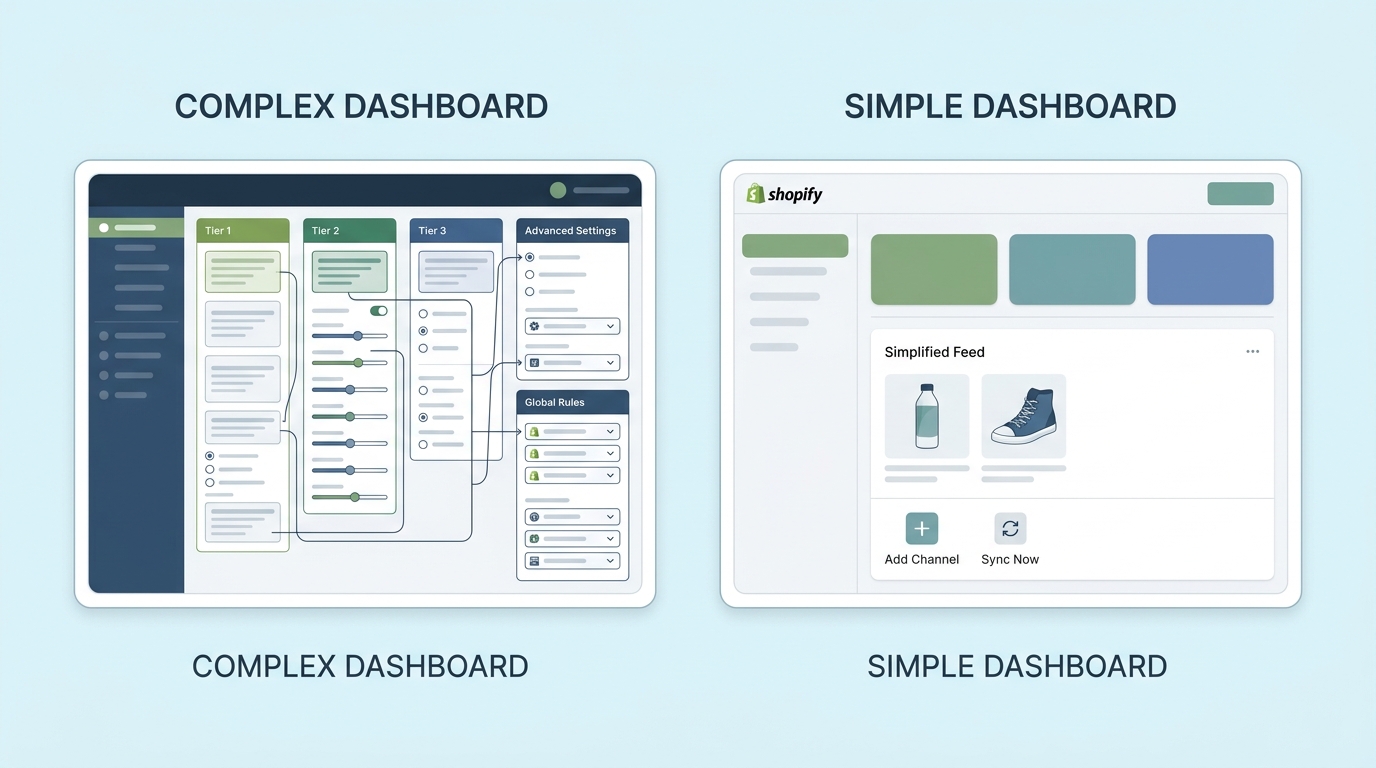
Here’s the part most vendor pages skip. If what you want is a big visual dashboard — a grid of every client you click through, with charts and status lights — the established platforms have that today, and we don’t yet. Our portfolio surface is agent-driven right now; a standalone visual dashboard is on our roadmap, not shipped. If a click-through control panel is non-negotiable for your team, the incumbents are honestly the better fit today.
What we offer instead is the operating model: run the portfolio by describing outcomes to an agent, preview-first, without rebuilding templates by hand in a grid — at a Shopify-native price that doesn’t multiply by your client count.
Which option actually fits you
- A handful of client stores with simple feeds: a per-store app is fine. Don’t overthink it.
- A large book, a team that lives in a rule engine, and a hard need for a visual portfolio dashboard today: an enterprise platform earns its keep. (If you’re weighing those specifically, our honest Feedonomics and DataFeedWatch comparisons go deeper.)
- A growing 5–50 person agency managing 10–100 Shopify stores, tired of per-store pricing and per-store clicking, and comfortable running work through an AI agent: the agent-driven model was built for exactly this gap. Affordable, Shopify-native, and portfolio-capable is a combination almost nothing else offers at once.
That last profile is the one the market has quietly left unserved. The cheap tools don’t scale past a handful of clients; the tools that scale aren’t cheap and aren’t native. An agent connected to your whole portfolio is a genuinely different third option — and it’s live today, not a waitlist.
If that’s your situation, the fastest way to feel the difference is to point an agent at a client store and ask it what’s wrong. Our agency page walks through the org-key setup and includes a free portfolio feed audit — we’ll run the same sweep an agent runs across your clients and send you back what we find.
Ready to simplify your product feeds?
Simple Product Feeds connects your Shopify store to Google Shopping, Meta, and more — in minutes.
Install Simple Product FeedsFrequently Asked Questions
- How do agencies manage product feeds across multiple client stores?
- Three ways. A per-store Shopify app installed on each client is cheap but doesn't scale — one subscription and login per store, no portfolio view. An enterprise multi-store platform like Channable or DataFeedWatch gives real portfolio management, but your team maintains rules and templates in a spreadsheet-style UI, per client. An agent-driven model connects one AI agent via an organization key that operates across the whole portfolio by request. The right choice depends on your book size and whether you'd rather operate a UI or describe outcomes.
- Do I need a separate subscription for each client store?
- With per-store Shopify apps, yes — that's their main limitation for agencies, because both cost and logins scale linearly with your client count. Agency-capable enterprise platforms and the agent-driven organization-key model are both built to span many stores from one account instead.
- How is an agent-driven approach different from Channable or DataFeedWatch?
- Those are mature multi-store rule engines: you centralize many stores in one account and build and duplicate templates and IF-THEN rules in a spreadsheet-style UI, per client. The agent-driven model changes the interface — you describe the outcome to an AI agent that operates across the portfolio, preview-first. Honestly, the established platforms have a visual portfolio dashboard today and we don't yet; the agent model trades that for running the work by request at a Shopify-native price.
- Is it safe to let an agent make changes on client stores?
- Yes. Every change is preview-first — the agent shows you the exact before/after and waits for your approval before anything publishes — and every change is recorded in a per-store audit trail. Nothing touches a client's live feed without your review, which is the accountability client work requires.
- Is there a portfolio dashboard?
- Today the portfolio surface is agent-driven: one organization key, one agent, every client store, operated by request. A standalone visual dashboard is on the roadmap, not shipped yet. We'd rather be straight about that than show a screenshot of something that isn't real.
Related Articles

How to Connect an AI Agent to Your Shopify Product Feed
There are two things people mean by connecting an AI agent to your Shopify product feed — and the operator one (audit, fix disapprovals, publish) is the one that saves you time. How to connect Claude, ChatGPT, and more, safely.
The Best Feedonomics Alternative for Shopify Merchants (Honest Comparison)
Looking for a Feedonomics alternative built for Shopify? Compare features, pricing, and find the right product feed management tool for your store.
DataFeedWatch Alternative for Shopify: An Honest Comparison
Looking for a DataFeedWatch alternative? See why Shopify merchants switch to Simple Product Feeds — Shopify-native, transparent pricing from $9.99/mo, free plan.
The Complete Guide to Product Feed Management for Shopify
Product feed management is more than syncing your catalog. Here's the complete guide to how it works, what breaks, and how Shopify merchants do it right.